
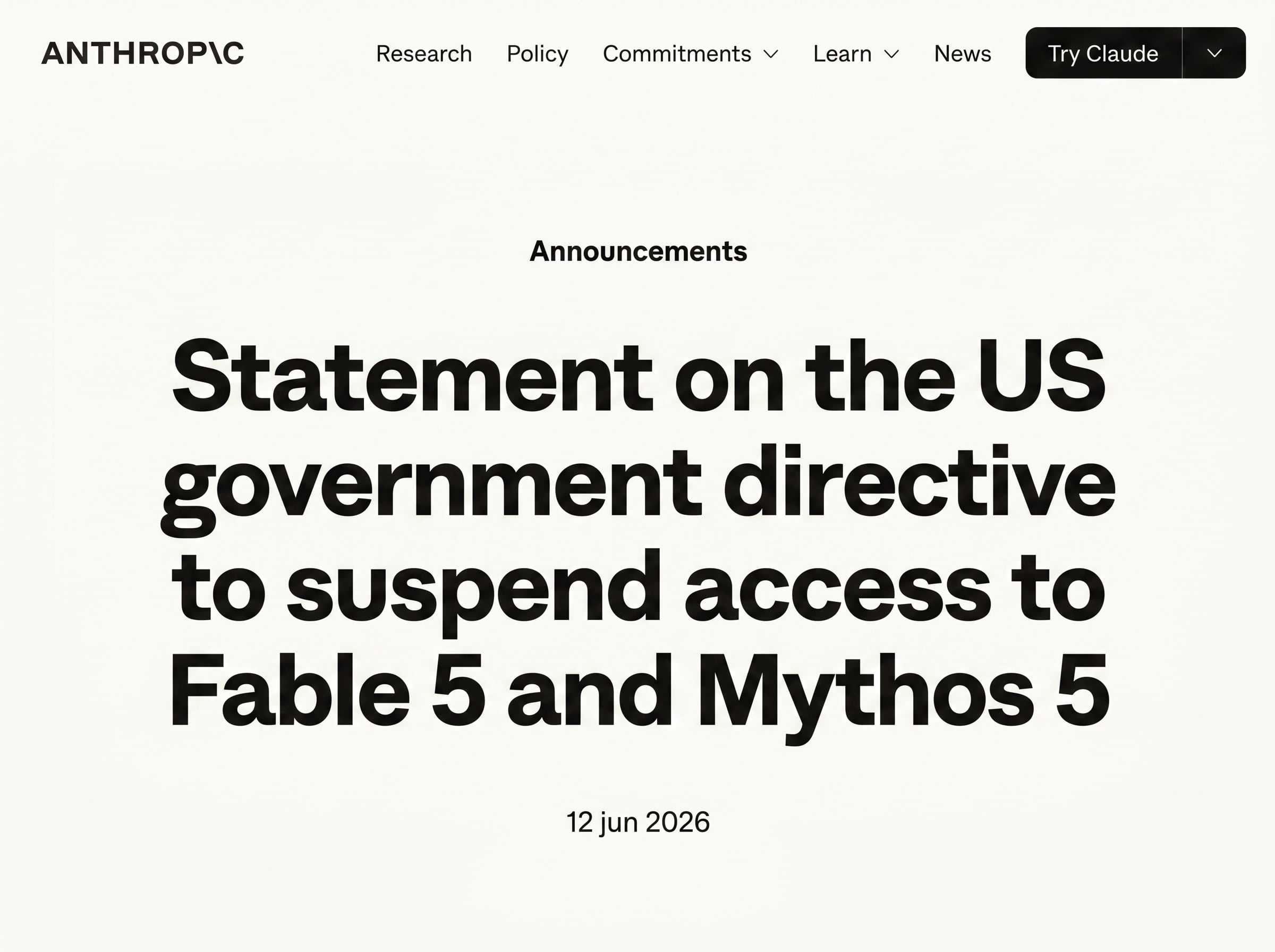
On 9 June, Anthropic opened the most capable AI model ever released to the public. On the 12th it shut it down by order of the US government. Here is what happened, with dates and official sources.
The launch: 9 June 2026
Anthropic made Claude Fable 5 available to everyone. A "Mythos-class" model, a tier the company itself places above its Opus range. State of the art on almost every benchmark measured: software engineering, knowledge work, vision and scientific research.
The figure that sums it up best came from the early testing. Stripe reported that the model compressed months of engineering into days: a migration across a 50-million-line codebase solved in a single day, work that would have taken a human team more than two months.
Alongside it, Anthropic released Claude Mythos 5: the same base model, but with the safety filters lifted in some areas. Reserved for cyber-defenders within Project Glasswing, in collaboration with the US government.
Price for both: $10 per million input tokens and $50 per million output tokens.
To launch it safely, Anthropic built safeguards that route sensitive queries (cybersecurity, biology, chemistry) to its previous model, Opus 4.8. According to the company, that happens in fewer than 5% of sessions. Before launch they tested those safeguards for thousands of hours, with the US government, the UK AI Safety Institute (UK AISI) and third parties. No one found a "universal jailbreak", a method able to bypass the filters broadly.
The shutdown: 12 June 2026, 23:21 CEST
3 days later, the US government issued an export-control directive citing national security. It bans access to Fable 5 and Mythos 5 for any foreign national: inside or outside the US, including Anthropic's own foreign employees.
The net effect was immediate. Anthropic had to disable both models for all its customers, including on Amazon Bedrock. The rest of the models, such as Opus 4.8, keep working normally.
The order arrived on a Friday afternoon and was applied all at once. According to Fortune and Bloomberg, it came from the Department of Commerce under the Trump administration.
The reason: a flaw Anthropic disputes
The directive did not spell out the specific concern. According to Anthropic, the government believes it has found a method to "jailbreak" Fable 5, that is, to bypass its filters.
But the company says it has only received verbal evidence of a narrow flaw: asking the model to read a specific codebase and fix its software bugs. Anthropic reviewed the case and argues that this capability is already available in other public models. It cites OpenAI's GPT-5.5 directly.
Its stance is clear. They comply with the order, but they disagree. They argue that pulling a model used by hundreds of millions of people over such a narrow flaw would set a precedent that, applied across the industry, would halt the deployment of any frontier model. They call it a misunderstanding and say they are working to restore access.
Why this matters to all of us
Until now, the debate about controlling advanced AI was theoretical. This is the first of its kind: a government switching off an already-deployed frontier model, overnight.
For anyone working with AI, the message is direct. Access to the most powerful tools no longer depends only on what the technology can do. It also depends on decisions made in government offices, sometimes within hours.
At GROS we work with AI models every day to produce images and video. Cases like this confirm something we have been clear about from the start: the advantage is not in depending on a single model, but in knowing how to move between the tools available at any given moment.
3 days of life. The question is no longer whether advanced AI will be regulated, but who presses the off switch, and with what evidence.
Sources
- Anthropic. Launch of Claude Fable 5 and Claude Mythos 5 (9 Jun 2026): https://www.anthropic.com/news/claude-fable-5-mythos-5
- Anthropic. Statement on the US government directive (12 Jun 2026): https://www.anthropic.com/news/fable-mythos-access
- Detail on the origin of the order (Department of Commerce): Fortune and Bloomberg, 13 Jun 2026.