
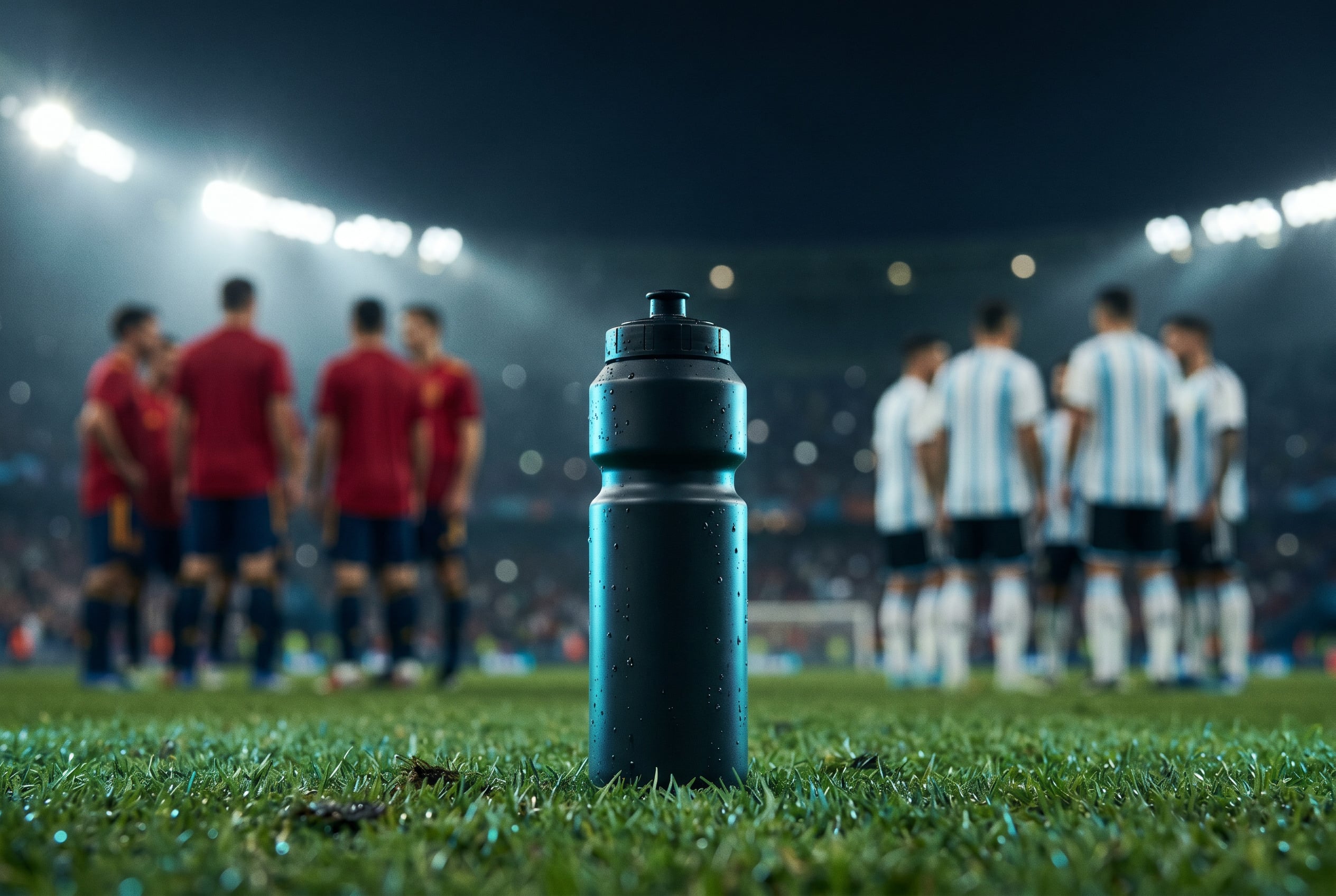

A 3-minute break. Between 500 and 600 million dollars.
That is the real maths of the World Cup "hydration break". A measure born to protect players' health that today works as one of the best-designed monetization machines in football. Some already call it bluntly: pure capitalism.
It is worth understanding how it was done. Because the lesson is not about football. It is about how you extract value from a product that seemed to have nothing left to give.
From medical need to commercial excuse
The hydration break dates back to the previous World Cup, in the Middle East. There the temperatures made it strictly necessary to stop midway through each half so players could drink and stay healthy. A health measure, no argument.
The problem is what came afterwards. That measure turned into a commercial excuse.
The example makes it clear. In a Brazil vs Japan match at the United States World Cup, players wore long sleeves, the stadium was covered and air-conditioned, and the break happened anyway. The official justification is still the same as always: the safety of the athletes. But in practice it is applied across the board, rain or shine, with no trace of extreme heat.
And here comes the first uncomfortable question. When a health measure survives in the one place where it is no longer needed, is it still a health measure?
The psychology of staying glued to the screen
Traditional football has a 15 to 20-minute break between the two halves. That pause is long. The viewer gets up, fetches a drink, makes dinner, moves around. They lose focus on the screen. And, along the way, they lose the ad breaks.
The hydration break lasts barely 3 minutes. And that is where the whole play is.
Psychologically, it is not worth getting off the sofa for so little. You stay. It does not break the rhythm of the match enough for you to disconnect, so you consume the advertising almost compulsorily. You do not skip it. You swallow it whole.
The result: guaranteed impressions. And a guaranteed impression is worth far more than one the viewer can dodge. The genius is not in the ad. It is in the exact minute they put it on.
The water was the excuse. The business is attention.
A hundreds-of-millions machine
The monetization is calculated to the millimetre.
FIFA authorized broadcasters to sell 2 minutes and 10 seconds of the 3-minute stoppage. The mechanics are precise: the ads start 30 seconds after the referee blows the whistle and the signal returns to the stadium 20 seconds before play resumes. Hundreds of new advertising slots that simply did not exist before.
According to New York Times estimates cited on the podcast, the sale of those ads generates a valuation of between 500 and 600 million dollars.
To put it in perspective: broadcasters like Fox paid around 500 million for the World Cup television rights. And they have been able to recoup that entire cost solely and exclusively with the ads sold during the hydration breaks.
Read that again. A whole tournament of rights, paid for with nothing but the gaps that appear when players drink water.
The Americanization of football
This was not invented from scratch. It shows the United States' skill at entertainment and marketing, copying the structure of purely American sports like basketball, baseball or American football.
Those sports base their model on constant interruptions designed to slot in commercial activations. In the NBA, for example, time-outs have a strategic function to halt the opponent's momentum. But they are also a tool to commoditize broadcast time.
Football, which for decades boasted of being the sport that never stops, has just copied the manual. And it has found that it works just as well.
The lesson: no product is ever finished
Here is what really matters, and it has nothing to do with the ball.
However established a product is, you can always give it a fresh twist to extract more value. Football is the most established spectacle on the planet. And even so, someone found a huge revenue stream where there used to be only thirst.
That is why the hydration break is not going anywhere. It will be justified by the heat at the Spain and Morocco World Cup. It will be justified by the desert in Saudi Arabia in 2034. And here is the irony that sums it all up: even if the World Cup were played in cold Scandinavia twelve years from now, the break would still exist. Not for health. For profit.
The game is no longer won by the product alone. It is won with distribution and with attention. Football's new money did not come from playing better. It came from placing the viewer's attention better. And that is the game being played in any sector, not just on the pitch.
The question we leave you with
If a three-minute measure to drink water can be worth hundreds of millions, the question stops being about football and becomes about your business.
What is the "hydration break" of your sector? That gap of attention in front of you that nobody is charging for yet.
And where is the line between creating real value and monetizing with a well-built alibi?
Because the trick was not inventing a new product. It was looking at an old one with fresh eyes.