
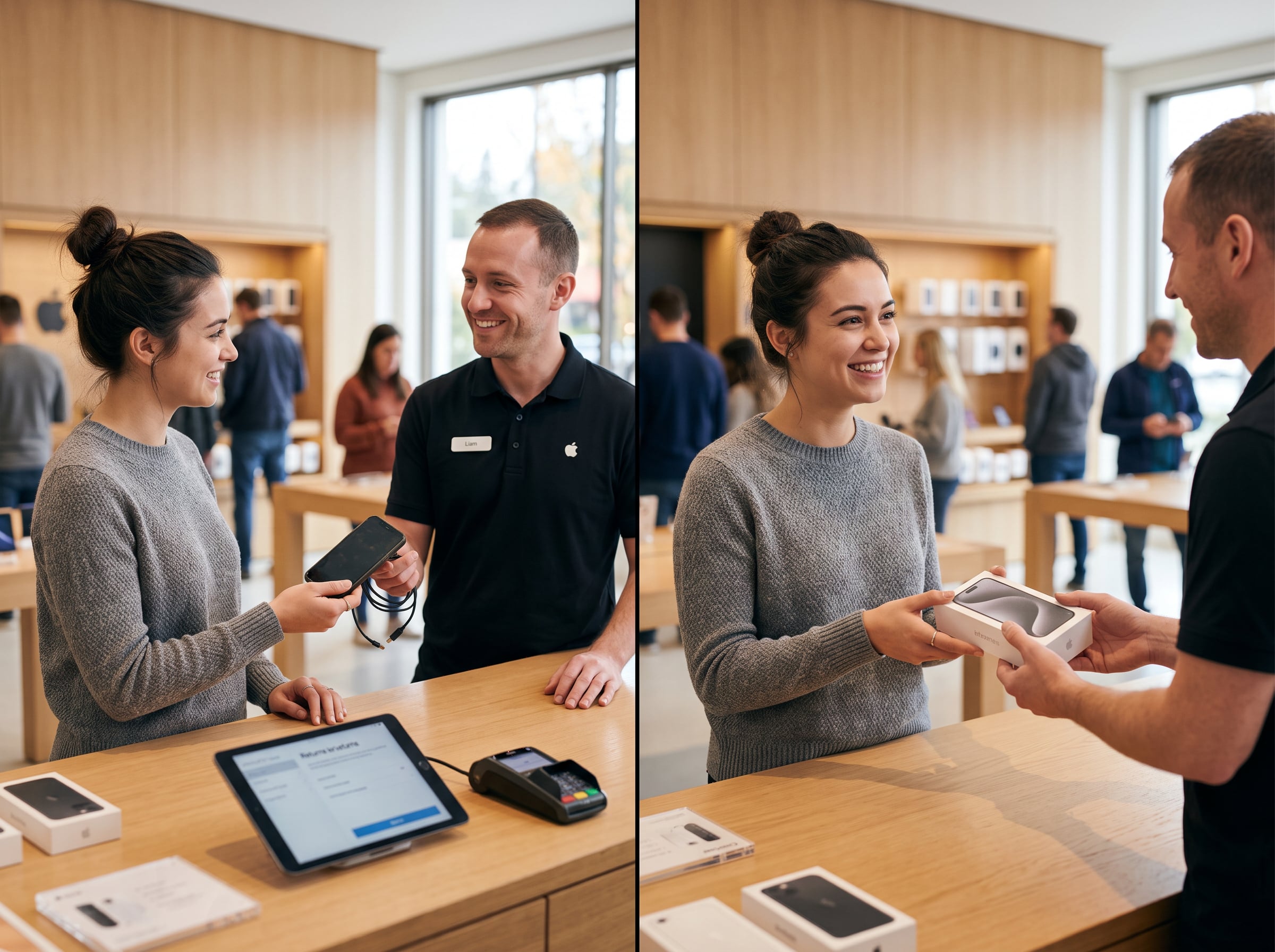
Apple has launched Apple Upgrade in the United States. It is a leasing program for iPhone, Apple Watch, Mac and iPad.
The news is not just financial. It is strategic.
Apple is not only selling devices. It is redesigning the relationship between product, renewal and ecosystem.
It is also worth cleaning up the market context. Apple briefly reclaimed the top spot in the world by market cap in July 2026, but as of 10 August 2026 it no longer leads the ranking. Nvidia is ahead. Apple is still in the fight, but you do not need to force that headline to understand the move.
How Apple Upgrade works
The program lets you pay a monthly fee for a device over 12, 24 or 36 months, depending on the category. iPhone and Apple Watch have 12- and 24-month options. Mac and iPad, 24 and 36 months.
Apple gives several reference prices. iPhone starts at 17.99 dollars a month. Apple Watch, 11.99 dollars. Mac, 24.99 dollars. iPad, 11.99 dollars. A concrete example: an iPhone 17 Pro with 256 GB, priced at 1,099 dollars to buy, comes to 31.99 dollars a month over 24 months.
At the end of the contract, the customer can upgrade to a new device, buy the current one with a single payment, or return it and exit the program. If they upgrade, they sign a new lease and return the previous device.
There is an important nuance. Apple does not literally become a bank. The lease is provided by Klarna. What matters is something else: Apple folds that financing into its own commercial experience and shortens the distance between desire, purchase and renewal.
Why Apple is doing this now
The useful read is in the model.
Apple knows the renewal cycle has stretched out. In the quarter ending March 2026, CIRP reported that 39% of iPhone buyers had kept their previous iPhone for three years or more. That figure explains the move.
If the user keeps the device longer, Apple has two paths. Wait for them to buy again. Or build a structure that turns renewal into a habit.
Apple Upgrade pushes toward the second.
Hardware starts to behave like software. Less one-off purchase. More recurring relationship. Less ownership at the center of the experience. More access, updates and dependence on the ecosystem.
The device is no longer just an object. It is camera, cloud, payments, health, entertainment, services, accessories and residual value. Apple controls much of that chain. And with Apple Upgrade it controls the entry point, the renewal moment and the return of the used product even better.
What your brand takes from this
For brands, the lesson is not to copy Apple and turn everything into a subscription.
The lesson is to understand what you are really selling.
People increasingly buy less of an isolated piece. They buy a system that keeps that piece alive. A product with no content, no story, no updates and no ecosystem competes worse.
The same thing happens in visual production
A brand does not just need an image. It needs a pipeline able to produce pieces constantly, with realism, control and taste. It needs campaigns, ecommerce variations, ads, social content, seasonal assets and deliverables adapted to each channel.
That is where AI stops being a one-off tool and starts to look like creative infrastructure.
Not as cheap automation. As a production system.
At GROS we work from that logic: AI visual production to generate hyperrealistic images, videos and models with professional quality, without a traditional shoot and with fast iteration. From brief to master in days, not weeks.
Apple Upgrade does not prove everything will become leasing.
It proves something more concrete: companies that control product, experience, renewal and content have more room to redesign how value is sold.
And that is the useful part for any brand.
The winner is not whoever uses the technology once.
It is whoever turns it into a system.
You can see how we apply this AI visual production logic in GROS for hospitality.
Sources
- Apple Newsroom, Apple Upgrade launches in the United States (28 July 2026): https://www.apple.com/newsroom/2026/07/apple-upgrade-launches-in-the-united-states/
- CIRP, Retired iPhone Ages Show Two Kinds of iPhone Owners (June 2026): https://cirpapple.substack.com/p/retired-iphone-ages-show-two-kinds
- CompaniesMarketCap, Companies ranked by Market Cap (accessed 10 August 2026): https://companiesmarketcap.com/